

The Immortal Choir Holds Every Voice
Margaret Killjoy
2025, Strangers in a Tangled Wilderness
Classified Under: Folk Horror, Anarchism, Monster of the Week, Characters are Queer and It Isn’t a Whole Plot Point
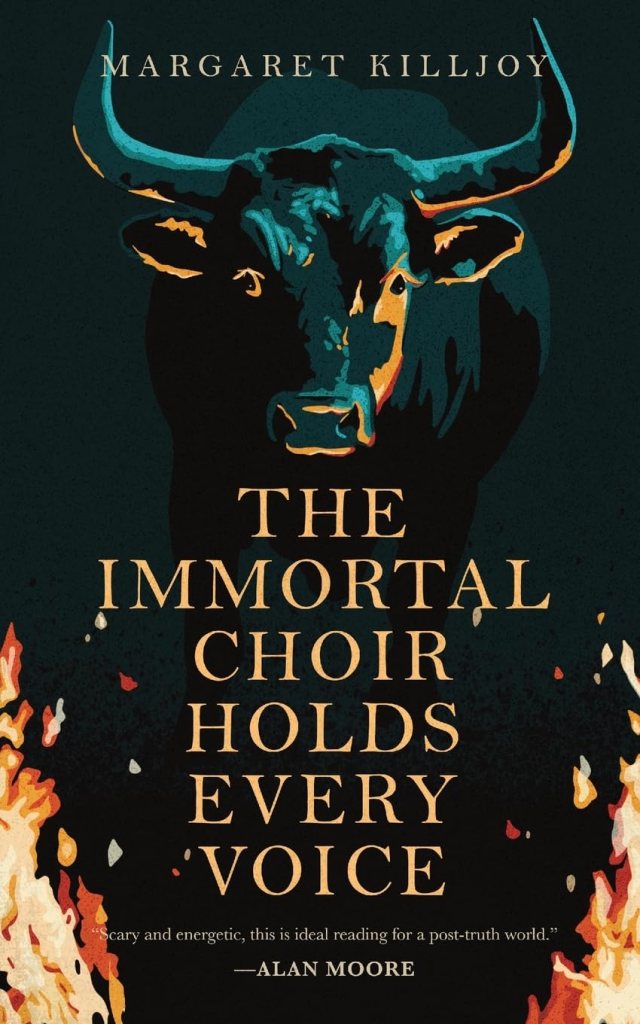
The Immortal Choir Holds Every Voice by Margaret Killjoy is the third installment of the Danielle Cain series. The first two book in the series The Lamb Will Slaughter the Lion (2017) and The Barrow Will Send What it May (2018) were published by Tor, whereas The Immortal Choir was successfully Kickstarted by the publishing collective Strangers in the Tangled Wilderness, a switch that increases the book’s accessibility in price and in form with affordable digital and audio versions forthcoming (seriously, the content they provide for five bucks is incredible).
In the first two books, Cain and the crew’s adventures are fast paced monster/demon of the week style reads that are—in a loose approximation of the cover blurbs—kick-punches of anarcho-punk fantasy that slap chop your face with thrills, chills, and politics. The Immortal Choir changes the series pace and opens in a moment of calm with the yet-to-be-named demon hunting crew, comprised of Danielle, Brynn, Vulture, and the Days (punk power couple Doomsday and Thursday), sitting around a campfire on Samhain (Halloween/November 1). “Calm,” in the Cain-universe, is relative, and in this case includes hiding from the magic feds in an Idahoan forest, haunted by the bellows from a cow/not-cow/potential demon. To distract from their surroundings (and in theme with the holiday, when the veil between the living and the dead is thin), the gang swap stories of fallen friends.
Each of the three chapters following the introduction is a story told around the campfire. Thursday tells a story belonging to Anchor, Vulture tells Rebecca’s story and Danielle shares a story she was told by Clay. Anchor, Rebecca, and Clay were introduced to readers in The Lamb Will Slaughter the Lion and the overall arch of the series adds quite a bit to their shared stories, however The Immortal Choir could be read as a standalone book thanks to the context provided by Thursday, Vulture, and Danielle. The stories, one of a troll king, one of murderous faeries, and one of protesters battling it out in Miami, are also a sort of collective rumination on the nature of magic and of community. Magic and community are central themes throughout the whole Danielle Cain series, but the telling of stories and the absence of action or conflict, provides the characters and the reader with multiple iterations of magic and community to consider together. The fact that The Immortal Choir can be approached as a short story collection makes it accessible for those who haven’t read the first two books but are curious (but c’mon, each one is around 100 pages and can be finished in an afternoon with a cup of tea).
The Immortal Choir picks up not long after the events of The Barrow Will Send What It May, but the seven-ish years between the publication of book two and three is felt given how much Killjoy honed her craft in that interim. Killjoy’s novellas in particular resonate with the moments in which they were written, and while the first two Cain stories and Escape from Incel Island (2023) are still timely reads, The Immortal Choir is a novella of the post-Trump-re-election world. In each story, the focus is never on defeating the monster, but on getting out. Getting out with your skin mostly intact is the winning scenario, maybe with another person alongside you. That there is magic in collective action and community may be central to the series, but The Immortal Choir offers a nuance of community action and magic in a time when hope may not be available. The tone is different, the structure of the narrative is different, and most importantly the questions Killjoy asks and works through are different. I devoured the book in one sitting and it’s sticking to my ribs weeks later.
Okay, now that the attempt at a useful and pithy a review out of the way, it’s time to buckle up (if you wish to continue the ride) for some niche and indulgent pontification. I had big feelings as I was reading because Killjoy intentionally captures something important about stories that delighted my Ph.D.-in-folklore-having ass (getting a good grade in folklore is both normal to want and possible to achieve!). Thinking about how people tell each other stories—not only the craft of it but how they are at once an event and a telling of an event—is an occupational hazard for someone in my line of work. The incredibly cool thing that Killjoy does with each story and the conversation that happens around it is portray the complexity of simultaneously telling a personal narrative and telling someone else’s. Our electrified meat brains are story machines and we are in many ways literally shaped by our stories. To wax poetic, the story you tell about yourself is never just yours; it is always a co-creation. Your story is always combined with the stories of other people, the stories of who you are in community with, and within the context of all that came before. (History and culture? Baby, that’s just a big ol’ pile of story.) This very human fact is at the heart of The Immortal Choir. Killjoy takes advantage of the linear/static nature of text in a way that makes very clear the way our voices also always carry the voices of others.
The nested nature of our words and others’ words and that power is at the very heart of this rumination on magic. As each story switches speaker, the narrative voice changes to match. Within the telling of each story, there are these moments when the reader is reminded that this is a story made up of another’s words. Each narration includes where the speaker was originally told the story (and other storytelling contexts!) and asides that that tell how Anchor, Rebecca, or Clay themselves told the story recalling the emotions and particular descriptions or turns of phrase. It’s not uncommon for characters in books to tell a story that is a personal narrative of someone else, but what captured my attention in The Immortal Choir was that I never lost track of who was speaking. The living narrator’s account of listening to the story was always distinct from the narrative told by the dead. The result is a story of holding space for the dead, of keeping them in community, and the magic of doing so.
Recommended Reads
- Anything else by Margaret Killjoy
- The Twisted Ones by T. Kingfisher
- What Moves the Dead by T. Kingfisher
©2025 Marisa Wieneke
Marisa Wieneke is is employed as an editor despite not fully understanding semicolons. She wrote about internet memes hard enough to earn a doctorate in folklore even though she only knows three facts about fairytales. Most of her time is spent being a lap for a dog-like creature.
 The Kismet Magazine
Leave a comment