

Black Flame
Gretchen Felker-Martin
2025, Tor Nightfire
Classified Under: Queer Revenge, Art As Resistance, Become What You Fear
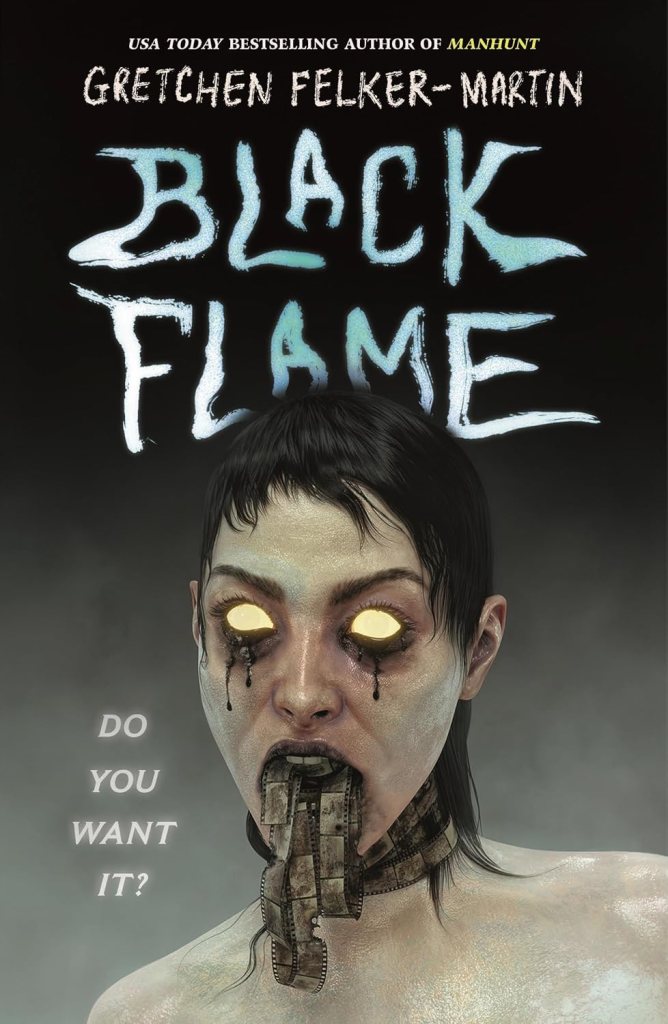
I had the privilege of reading an advance copy of Black Flame before it released in August, the third novel from Gretchen Felker-Martin, author of Manhunt and Cuckoo. Felker-Martin’s previous two books absolutely blew my mind. To say that I was highly anticipating Black Flame would be a colossal understatement, and it absolutely did not disappoint. I am an avid consumer of queer horror, especially in literary form, and this was almost too perfect for me.
Black Flame’s protagonist Ellen is a young Jewish woman working for a film restoration project and struggling with her own repressed queer identity on top of her family’s high expectations. The first chapter opens on Ellen’s first exposure to The Baroness, a WWII-era film by queer artist Karla Bartok, who was ultimately targeted and killed by the Nazis. The film follows a young man (played by Bartok’s lover, Ilya Kapfelberg) as he journeys through the Baroness’ castle, encountering her strange associates who involve him in their devious and supernatural acts of queer sex, torture, and blasphemy (to name a few), before he reaches the Baroness (played by Bartok himself) and is beheaded in an erotic display of cruelty and devotion. The film was thought to be lost after the Nazi raid on Bartok’s home in 1935, but the negative and several prints were recovered from the apartment of a recently deceased Nazi official who had been involved in the confiscation of several queer artifacts, including Bartok’s work. While restoring the film, Ellen is forcibly drawn into its story as if it were an entity of its own. It forces her to confront her visceral reactions to its content and sets her on a violent journey of self discovery while the characters slowly bleed into her life
In my experience, a lot of pressure is put on members of marginalized communities to forgive and have grace for the oppressor. The concern with grasping for every little bit of credibility we can is, unfortunately, not one I see going away anytime soon for queer people. Luckily, there’s nothing stopping us from indulging in a little revenge fantasy every once in a while to keep ourselves sane. Felker-Martin has proven herself the empress of queer revenge with every gritty vision of justice she gives voice to, and Black Flame is no exception. Without spoiling the book, I can say that Ellen’s bloody battle with herself and the world around her is not one fought in vain; as I’ve come to expect from her creator, she exacts her pound of flesh when the time comes. Maybe it’s not for everyone, but there’s undeniable value in seeing fictional justice served in the most gruesome possible manner.
Another aspect of Black Flame that I particularly appreciated was its commentary on censorship as both a past and present issue. As a bookseller, censorship is an issue I regularly concern myself with professionally, but frankly, it’s a perennial issue that comes with the queer literary space. It was remarkable to me that this book was able to tackle such a vast issue so deftly with everything else that it has going simultaneously, but I don’t think Felker-Martin could write a shallow book if she tried. It could be that she’s reaching directly into my brain and pulling out exactly what I want to read, but everything she writes makes me think (in the best way). As a queer author and a film critic, she has a familiarity with censorship that can only result in some extremely well-developed ideas on the issue, and it shows in Black Flame.
Felker-Martin’s voice never fails to draw me in. As soon as her words slither into my mind, I’m connected to the characters, their story, and the author herself. I find myself intertwined with the life lines of queer artists everywhere. The authenticity and imperfection of the players in Black Flame was immediately clear to me. Ellen’s profession of literally bringing lost art back into the light serves as a perfect anchor Felker-Martin’s exploration of her bloody struggle towards self-discovery. This was an extremely satisfying (indeed, cathartic) read, and I encourage queer people and horror fans to get intimate with Gretchen Felker-Martin’s genius writing.
Recommended Reads
- Tell Me I’m Worthless by Alison Rumfitt
- Bury Your Gays by Chuck Tingle
©2025 Finn Champagne
Finn Champagne is a bookseller and an enthusiastic consumer of queer horror in all its forms, especially literary. He relishes any opportunity to share his thoughts and discuss with fellow connoisseurs of the grotesque. A recently inducted Chicagoan, he still holds Bloomington, Indiana, dear.
 The Kismet Magazine
Leave a comment