
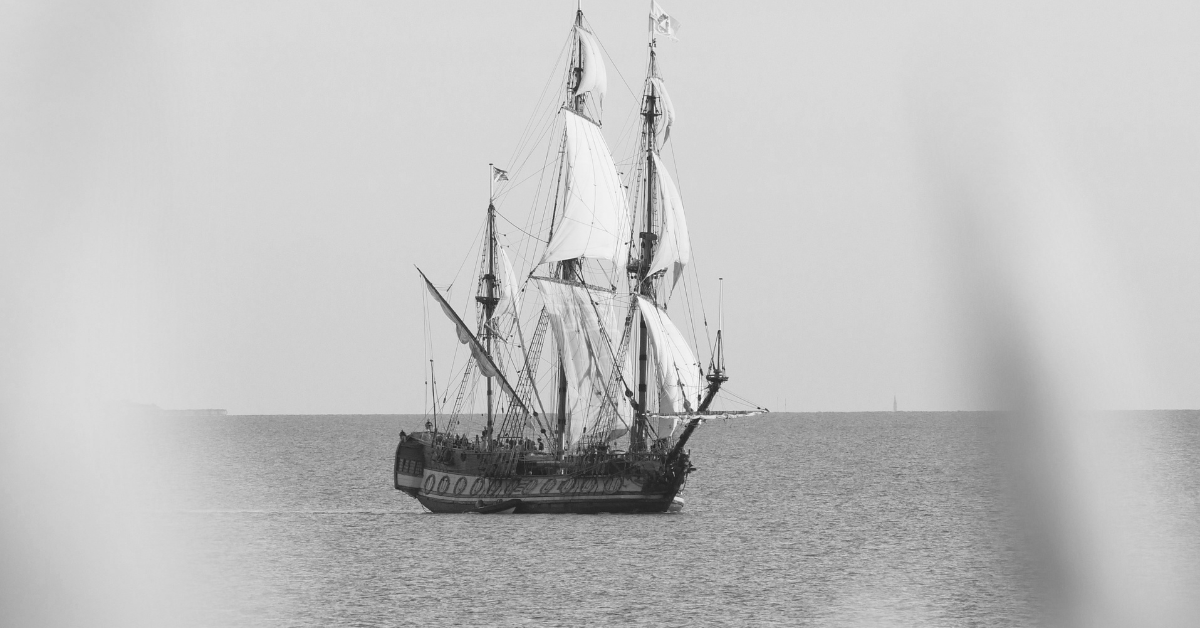
Suppose there were a ship’s captain who sixteen times over failed to deliver a single passenger to their promised destination. What might you think of him? He is a seasoned captain, a hearty forty-eight years at sea, so you needn’t think him a fool. Though if he were, I might find relief. If in mindless incompetence he inverted his celestial readings so that his northern route from San Francisco to Taizhou turned south. Of course, even if he were a fool, no ship captain could mistake the tropical island for the mainland. Even the passengers knew Taizhou from that seeming paradise, and not one would have left the ship if they knew what lay beyond the sand. Echo Island is a cursed place.
The captain knew. Six years he knew the horror of the island as he would know me from you, or as well as he might know himself, and six years and no less than fifteen voyages he stood forecastle bound and watched and awaited the fate of those who ascended the golden shores. It is not a question of guilt; it is a matter of penance. If he’s not without soul, then of consideration is simply intent, because surely, there is nothing so evil in this world that acts for evil alone.
It is not for money, though a man who sells his soul for something can be reasoned with; it is neither greed, nor wrath, nor envy, nor even ignorance that drives our captain—for he is precisely aware of the lives he sacrifices and he knows his own depravity, even if he knows not why he does it.
And here you might think like I, and say, “Who cares of reason? The man commits atrocities, his mind is sound, he knows his worth, let us nail him against the harbor walls!” And you are right on all accounts, but for our captain he cannot confess. It is how you claim—he is clear of mind, he knows his worth and as such would present the hammer and nails to the hangman, and yet whether by cowardice or devil’s guile, he can’t speak of his crimes. When he begins, he speaks indirectly on the matter, circling through strange stories, admitting nothing outright. And try as he might to cast himself before the law, his legs take him nowhere beyond his ship and this tavern. Of course, without confession, victims would be irrefutable proof, but though none of the 483 passengers have returned in six-odd years, there’s been yet a whisper of suspicion, as if they disappeared from earth, mind, and memory.
With no victims, no family, no suspicions to be had, if his cowardice prevents confession, then why not take a flintlock’s iron to hell? Your question betrays a naivete of the crime’s horror, and I ask, What justice is there in suicide? If there be a shipwreck’s hope at sea that he find sentence for his sins, our captain would not deny it. And besides, no haunting is so terrible, no punishment greater, than the weight upon a guilty soul. The captain will torment himself until what fateful tide comes in—and it will come in, it grows closer by the day. You see, though each passenger is the alike, they praise the captain, ask for passage, heed no mind to tale or caution, there are those on occasion who break the ritual and allude suspicion.
Our captain was closest on the tenth trip, when an officer from the East Indian Trading Company asked to personally examine the captain’s maps. Though our captain’s gaze did not betray his state of mind, he knew that upon inspection the officer might uncover the impossibility of their journey and reveal the seaman’s wickedness. Francis the white-chested barkeep set down two foaming ales, and to the captain’s vacant expression, the officer laughed.
“You must forgive me,” he said, “but I am familiar with the manner of sailors. Rest assured; I dare not dream of telling a captain how to sail. Quite the contrary. You make the trip in a fortnight which oft take two or three—I aim merely to admire your plots. Should it interest you, my company would offer a generous wage to sail in our fleet. We are in the business of goods, not passengers, which, I imagine, might even be appealing for a man like yourself.”
The offer was tempting. It would tear him from his treacherous spiral of murder, free him from guilt and the long-awaited reckoning, which is precisely why he refused. “Nay,” the captain said, “I’d not take a deal that parts from passengers, my crew, and my ship. As for the voyage maps, I will—once we’re a sight’s away from shore—allow you to examine as you might.”
The officer raised his stein. “I understand completely,” he said, “and I agree to your terms, though you will forgive me if I am persistent with my offer. I do have a fortnight to change your mind.” He stood, shook the captain’s hand, and his fate was set.
The officer was just one of twenty-eight let loose from the foggy docks the following morning. It was a light fare by comparison, though among the fated cargo was a mother and a boy of no more than seven. Here I needn’t say how wretched this captain was, and yet by a ship’s length this boy was not the youngest fed to the Echo Island beast.
Under clear skies the sun curved over the ship’s length for three days and then widthwise on the fourth, but not a passenger aboard noticed the southern turn. The officer, among the ignorant, parsed the captain’s plots and merely noted the added southern stop.
“Amazing,” he said. “This far south, and you still make the journey in no more than seven nights. It is truly remarkable. There must be a northwestern current just across this archipelago that drives you north into the mainland. That must be your secret, yes! You, Captain, are a cunning devil!” The officer bounced his finger off the map, proud of his deduction. He stood up straight and paused. “But I should say,” the officer started, again leaning over the map, “if you weren’t to spend a night at this island, but cut across the islands to the north, you could hit the stream in a single night, reduce the journey to five days.”
The captain sat silently, his arms crossed.
After a moment, the officer said, “My apologies. I promised I wasn’t in the business of telling captains how to sail, and here I am doing exactly that.” He threw up his arms and straightened his uniform. “I am sure there is good reason for your route. But do know that I am stunned—yes, stunned!—by your shrewd sailing. Bravo, sir!”
Each night, the ship’s crew and her passengers gathered in the creaky mess hall and by candlelight shared their supper. Where most transoceanic voyages anchor, find safe harbor, or, if hurried, keep a sailor at a moonlight helm, Serenity’s Siren drifted nightly about the open ocean while the crew and passengers ate.
This was the only kindness the captain could provide, and in his own disheartened speech, he told his crew, “As the arbiters of their horrific ends, we must share the time they have left. If our heedless abandon of the helm lead us toward the deep unknown, so let it be. As profound as our corruption is, it would not be undeserved. We will not, in their final moments, treat our passengers as anything less than our own salt-blooded kin.”
Though the captain prayed their nightly aimless sailing would find them wrecked on jagged rocks, the ship stayed the course, and the solemn evening suppers repeated endlessly. Sailors stared dark eyed into their tasteless stew while the passengers nibbled carelessly on biscuits. The officer, with unwavering enthusiasm, spoke longingly about his adventures, his wife, their unborn child. Passengers indulged him, and though none shared the glum countenance of the captain and his crew, The captain savored his suffering, penitently remembering that after one final sunset, the passengers would be forever lost.
On the sixth night, black as the ocean’s mouth, the bow slid upon the shores of Echo Island. Beyond the gentle lapping waves, all was silent. On deck, the officer approached the captain, standing as still as shadow.
“Captain?” the officer asked. “First, have my assurances that I am not questioning your expertise on the matter; my regard for you is among the highest, but if this speck is our one stop, how is it that we will make the shores of our destination in a single day? Are we not still a thousand nautical miles from the mainland?”
The captain surveyed the void, searching for the dim bulbous eyes between the trees, anticipating the morning’s horror.
“Ah,” the officer said, dusting one of his epaulets. “Now I see. You find haste in the voyage back, not out. That’s why you let me inspect your route—not a soul beyond your crew could know your secrets, a clever sailor indeed!” The captain opened and closed the fist he held cross behind his back and said nothing. “Well,” the officer said, “regardless, I imagine after first light we will waste no time. But it is late, and I will leave you to your evening’s contemplation.” The officer began to walk to his chambers.
“Sir,” the captain said, still facing the darkness. “I’d ask a favor of you.”
The officer smiled. “Anything. At sea, I am your humblest of servants. Call me Thomas.”
“Ay. Yes. Thomas.” The captain uncrossed his hands and gripped the taffrail. “Tomorrow when the light hits the mast and the shores shimmer, I would ask that you not leave this ship.”
The officer scuffed the toe of his boot across a spot of bird filth and considered. “You are a mysterious man, Captain,” the officer said. “And what, pray tell, might I find on this island? Secrete, perhaps, you hope to spare from the prying eyes?”
“Your eyes can explore as they wish, so long as you stay aboard.”
A silence grew between them, and the captain never felt so close to relief. It was a simple thing for Thomas to invoke his authority, demand a confession, and seize control of the ship. He was closer than a breath to a candle’s flame.
Thomas laughed. “A jest, my captain, a jest! Oh, what wonderful treasures must this isolate paradise hold! Extraordinary, I’m sure, to pique the interest of a man so humble!”
The captain gazed down beyond the edge of the deck, where sand and water met mere meters below, but saw nothing.
The officer’s laughter waned. “But yes, of course. On my honor, I will not set foot on this island. Be it a veritable paradise or pirates’ den, I shan’t leave this modest deck.” Thomas drew close, placed a hand on the captain’s shoulder, and whispered, “Though, don’t presume I promise never to return.”
“What islands you visit on your travels, that business be your own.”
The officer, in the lantern’s light, patted the captain once. “Too kind of you. I trust your sins aren’t buried here. Perhaps hidden somewhere on the voyage back, when only a loyal crew might know what evil lurks at sea.”
The captain’s lips would not open, his bones were as rigid as stone, he couldn’t so much as tremble beneath the officer’s breath.
Thomas broke from the captain’s side. “Keep your secrets,” Thomas said. “I’ll see you at sunrise.”
When the deck was abandoned, and lantern’s light faded, the captain returned to his quarters, sat on his cot, and stared at the discolored curves that outline where a painting once hung. It was a portrait, and though it was removed only a few years prior, the captain could never remember whose likeness it was. He remembered the brushstrokes, the shading behind the man’s head, the faded and cracked gold buttons running parallel down his chest. In the portrait, there was a line painted across the young man’s cheek, an old wound from a pirate’s blade, when the stranger stood valiantly, refusing to surrender his vessel. But there was no noble captain there, only a faded impression. All night the captain stared. He stared at the spot on the wall until the wood slithered, splintered, and writhed. In his staring, as the wall twisted, there was a thought, no louder than whisper, that perhaps his nights of unbroken gaze revealed a ripple in the fluctuating veil of existence that remains still under the daylight’s passing glances. But before the thought could root, through a portside window, the light crept in, and our captain descended upon the deck.
He waited obediently for the sun to slide across the sand, and when it did, a hum, deep and hollow, bloomed from the heart of the island. It grew loud and heavy shaking against the ship.
“What is that?” Thomas asked, stepping out from his quarters already in his formal wear.
“You’d do well to remember your promise,” the captain said.
“Is that the wind? Or is the earth quaking?”
The captain stood silent, helpless, cemented to the creaky planks.
Soon the deck was full of anxious passengers peering over the ship’s edge into the forest just beyond the sand, and slowly a soft beat began to shake the leaves of bushes, growing louder, meeting and nearly overtaking the lowly humming.
“There!” yelled the little boy, tucked between his mother and the railing.
The passengers swarmed to where one could see, only faintly, a shadow just beyond the trees swaying in step. Now, at first glance, the creature does not chill the spine the way some sea beasts and forest demons might. Stepping out from the last sliver of shade, one could just see the beast snapping its jaws shut. The humming ceased. Twice the size of a man, it stood on two legs just below the tops of the trees. It was round, fatter than a seal if a seal were its size, and coated in dense fur as soft as mink and dark except for a diamond patch of white on its protruding belly. Its legs were disproportionately short and thick; the creature likely could not, if it needed, outrun even the boy, still awkward in his youth. But its arms, though equally thick, were longer and even dragged while it walked, leaving a pair of four scratch marks in the sand. For the passengers, the beast was curious; for the crew, it was a horror beyond imagination. Too far to see from deck, the creature’s face was its own sight to behold. The head, with cheeks like sails, drooped from scalp to shoulders, as if it wore a fleshy hood. Its nose had no frame, but two holes, and its large lidless eyes, like cannonballs, were white save for black pinpricks that darted from point to point.
“What a creature!” Thomas said. “Captain? Captain? What is that?”
The captain said nothing.
“Is it safe?” one passenger asked.
“It’s just standing there,” Thomas said. “Surely it can’t be that dangerous. When do we set off, Captain? I must take a closer look.”
The creature unsealed its long lips in a thin crack, and the humming resumed, now softer. Thomas quickly and with great curiosity descended the starboard ladder and, while keeping a distance, approached the creature, and the passengers did much the same until they were all bunched up on the beach. The creature closed its mouth, and the humming ceased.
“What is it?” the boy asked.
“Looks like a bear of some sort,” his mother said.
“It’s magnificent!” Thomas said. “I’ve never seen a thing like it.”
The boy twisted from between his mother’s knees and ran nearer.
“Samuel,” she hissed, “you’re too close.”
The beast, its terrible eyes focused on the child, slowly opened its mouth wider and wider till its jaw rested eyeline with him. The humming resumed, descending from an inaudible pitch. Its tongue, like a rolled-up rug, fell out of its gaping mouth. The boy, with little caution, climbed the red slide up into the monster’s jaws and peered inside.
“Mommy,” the boy yelled, “there’s something inside—a person. There’s a person inside.”
“Samuel, come back here,” she called, a subtle waver in her voice.
“Just a quick look,” he said, and before anything could be done, the boy slipped out of sight.
There was hesitation, as there often is in the lifeless moments before an impending tragedy, when hope is but a wick’s ember. A sharp, tortured scream pierced out of the creature’s mouth and stopped as quickly as it began. The mother, her dress pulled up on one hand, tore and scrambled up the sand, but was overcome and held back by the passengers.
“Wait!” the boy cried.
Inside the gaping mouth, just above the edge of the flat red tongue, Samuel’s head rose up. “Wait,” he said again. “I’m okay. Mommy, you won’t believe who it is!”
“Samuel?” the mother said.
“It’s me, Mommy!” Samuel’s head drifted side to side, bobbing as if he were on a boat in light waves, raising some, though never enough to see below his neck.
“Mommy, it’s Mary! Mary is in here, she’s safe. I found her!”
The captain clenched his teeth till he felt they might crack.
“Samuel,” the mother said, “Mary is with the Lord.”
“She’s right here, Mommy! She’s not sick anymore. Come—come play with us!”
The voice of a little girl cried in joy, and the woman fell weeping, wrenching the sand in her fists.
“And Douglass,” Samuel said, turning toward a passenger in suspenders. “There is gold in here. Enough to pay off collectors, enough to get your home back! Come look.”
The group buzzed with whispers just veiling the growing hum. The man in the suspenders, Douglass, pushed his way to the front, climbed the short steep tongue. He peered inside, glanced nervously at the crowd, and slipped out of sight.
“Margaret? Where are you, Margaret?” The boy’s head looked left and right, swaying on a strangely long neck. A woman stepped forward, young and clean, her hair held up with a golden pin. “There you are, Margaret. The fortune teller was right: I found the fruit, it’s here, it’s here. It’s just as she said, I just know it’ll help your Timmy’s cough. Come on, come see!”
“Do you know this boy?” Thomas asked the woman.
She shook her head. “But I have to look,” she whispered. “I have to.”
One by one, each passenger was lured into the beast’s mouth, each ruse as thin as the last, till only the weeping mother and Thomas were left.
“Mommy? Don’t you trust me?” The low hum grew louder till the beast’s fur trembled. “Mary wants to dance again. She misses you. Come play with us, Mommy.”
In a fitted frenzy, the mother lurched upward, ran straight up the tongue, and jumped into the mouth, falling out of sight, pulling the head down with it.
Thomas stood dumbfounded on the beach. He turned to the crew and captain, who stood on deck silently looking on.
“What madness is this?” he cried.
“Vice Deputy Officer Thomas Willhem!”
Thomas spun toward the creature, who had out of its mouth a new head, older and mottled, hovering just above the tongue.
“Director Baring?” Thomas asked.
“Yes, Thomas. Good work. We’ve been waiting for you.”
“We . . . ?”
“Yes. The chairmen and I have been deliberating on a new officer to head the Pacific routes, and—I’m sure no surprises here—you are the obvious choice. Now, we’ll need to formalize the arrangement, so if you wouldn’t mind popping in for a moment to sign the—”
“This is ludicrous!” Thomas shouted. “What devilry is before me?” He turned again to the captain. “What cursed island have you brought us to?” The officer stepped toward the ship, but the humming grew loud yet again till the sand danced along the surface.
“Know your place!” the head boomed.
Thomas pulled at his leg but could not move away from the beast. “You are not Director Baring,” he said.
“Am I not?”
“Baring is in China,” the officer screamed. “This is insanity. I won’t entertain this, you—you demon!”
“How dare you disrespect a commanding officer,” Baring said. “Listen to me now. I don’t care how unorthodox this may seem, you will respect your rank. Given the unusual circumstances, I will find my patience and forgive the insubordination, but you will know your place. On occasion we and the council seek means and methods outside of the usual scope of operations, something you’d be well privy to had you already signed the paperwork. While competitors try to build faster ships, we’ve taken to diversifying our assets and finding novel solutions to more forgotten problems. This beast—Frank, as we call him—is one of many inhabiting the surrounding islands. What they lack in haste is found in their brute strength, lifting fifteen times that of a man, and despite their size work for a measly pile of fruits paid out once per fortnight. They are obedient—Frank, wave to officer Thomas”—the creature drew a long arm and waved it lazily—“very good—and more fortunate still, inside their bellies is room enough for an entire fleet of desks and offices, all of which reduces our operations overhead costs significantly.” The humming grew surreptitiously, shaking now sending small waves in the shallow sea.
Thomas stepped forward and paused.
“I understand your reluctance, Thomas, but if you’ll just look, you’ll see everything is in order. Should you find yourself not thoroughly comfortable with these conditions, you may keep your current position, and I and the other chairmen will respectfully rescind your promotion. Now, before you decide, let me show you around—if nothing else, to put your mind at ease.”
Thomas approached, and the director’s head snapped out of sight. Thomas climbed up the slippery tongue and peered into the chasm. “Director? Are you there?”
The tongue bumped, and First Officer Thomas fell headfirst into the monster’s gullet and the mouth shut. The creature looked to the crew and held a ghastly stare, and then with the slow cadence of a processional drum, it lumbered back into the forest, where the humming finally stopped for good.
Now, before you claim our captain is less evil, or heaven forbid innocent, rendered as he was paralyzed and mute by the creature’s will, let us not forget the trips themselves, the months between, that potent want of confession, and the actions precipitating all sixteen trips to the demon’s island. What clemency you may afford him, know for certain that he is not without guilt. He sailed his ship to that island, spoke of nothing to the passengers, knowing precisely what end he drew near.
Though the first trip, mind you, was an unfortunate twist of fate. The ship Serenity’s Siren drifted ashore after being tossed in the ripping winds of a typhoon. They stayed the night, and in the morning the beast emerged. The humming swelled, lured the seamen to the shore, and with some haunting impersonation convinced the sailors one by one to fall into that hollow mouth. The captain, however, still at the time noble and pure, had no such earthly wants to entice him, and so the demon showed another face; it showed that of the captain himself.
The floating head slithered on a long tendril and met the captain face-to-face. It told him that to release his crew from the hell inside its belly, he would have to take their place. It said in the captain’s own tongue, “Give yourself. Suffer the noble hearted, for there is no sustenance more succulent.”
The captain of course made no such deal, for while he is a loathsome man, he would not reason with a demon. He chased the head, swinging his blade wildly, and dove into the beast’s throat to cut free his men from its belly. But down where there should have been a black void, or the dripping chasm of a fleshy hell, was instead a beach much like the one he had leapt from. The tongue faded to sand, and the captain fell downward toward an endless ocean stretching out toward a bottomless horizon. The earth pulled him close, he slid onto the beach and rose to meet his opponent, but the creature was gone.
To this day the earth feels askew beneath his feet, and in silent moments he still hears the humming. His crew he found along the shores, swaying, and lumbering as if drunk. On the return trip, the best haunted our captain’s dreams. The sea felt still, even in the wildest swells, the familiar now unfamiliar, and in cold sheets the captain woke in a fit one night in chambers not his own and saw a portrait of a stranger, enviably in character, and if it had not looked down upon the captain, he might have left it hanging.
At port he walked straight to this dim groggery as if he had been here before and slumped at this damp booth as if he had already set up residence. Francis, the white-chested barkeep, placed a stein of ale, then another, and another. The shame, this compulsive guilt that torments him, was written across his face the moment he ducked below the threshold, and Francis took pity. He let the repulsive captain haunt this seat between voyages, to drink his sorrows deep, to drink for sleep, to drink for what he’s sown to—
Except no, that’s not right. On the first trip he returned with his crew in tow and had yet to feed any passengers to the beast. There must have been some other reason he came to this pub. Grief and guilt erode memory, it was a deal he made, a debt he owed that left him penniless and alone—yes! That must be it, and it only further reveals the barkeep’s kindness, sparing ale for nothing. This is also why our captain then agreed to give passage to that young woman, his first passenger. She sat where you sit, and claimed the captain was lauded as a noble nautical master, and that he was a man who would not cheat her of a single coin. She reminded him of the man he once was, and he welcomed her on board.
Then it began. Three days passed, and a man approached, praised the captain’s virtue and talent, and paid for voyage to Taizhou. Three days another, then another. Those early journeys were simple respites from the pleasant tune the barkeep hummed, from his undeserved kindness and endless ale. The captain left all wages for Francis, of course, and only returned each trip more haunted than before. There was a time when our captain once believed that this cycle would end. That his vile nature would cement on his cheeks, and the strangers would recognize danger in a scarred and hollow expression. But it’s a distant feeling now, a memory that might’ve been a dream. He has accepted his lot. He will sit in this booth and drink until one such as you braves to warm the bench across from him and ask for safe passage as if the ale-soaked tale faded beneath the barkeep’s hum, or perhaps, worse yet, never passed from the captain’s wretched tongue.
©2026
Leave a Reply